
Fouquieria splendens
Fouquieria splendens (ocotillo)
Fouquieriaceae
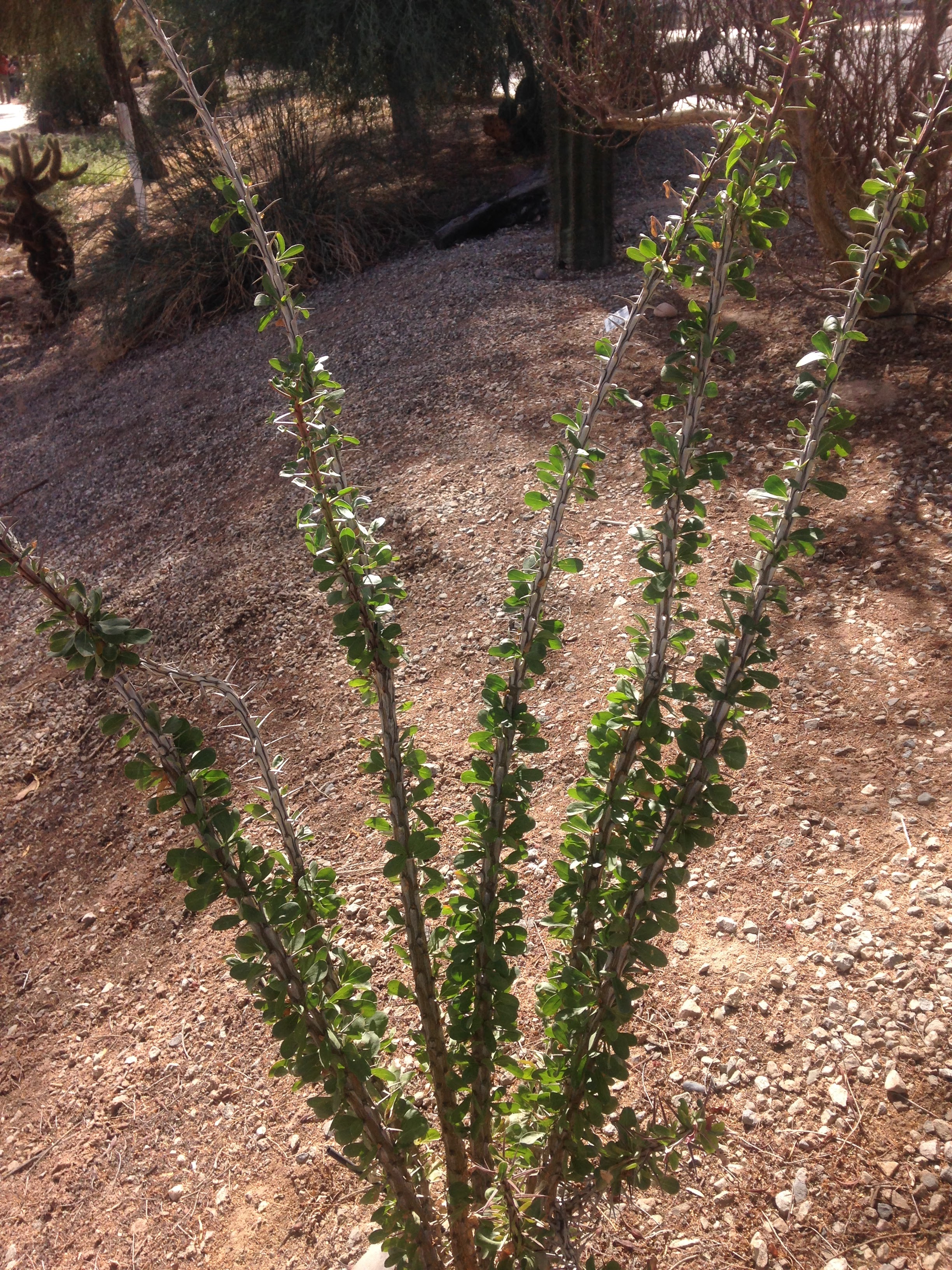
- Ocotillo is an unusual species with a remarkably wide range across the entire Sonoran Desert and into the Chihuahuan Desert. It is one of only a few woody species that naturally occurs in both desert regions. The spiny stems of ocotillo are highly distinctive, giving the appearance of tall wands or carriage whips. Perhaps the most remarkable feature of the ecology of ocotillo is how rapidly it responds to rainfall. For most of the year ocotillo stands leafless, but following a significant rain event it produces new cohort of leaves may remain on the plant for months. Under such conditions, showy red flowers are produced. With less rainfall, the leaves have a relatively short life span; they dry out and are shed within a few weeks. Ocotillo demonstrates remarkable flexibility in its ability to produce as many as five to six times in a season if rains are scattered. At the other extreme, in a dry year, leaf production may not occur. The stems of ocotillo are green and maintain a small amount of photosynthesis when the plant is leafless. The rate of photosynthesis by these stems is low, and probably serves only to balance some o the metabolic costs of respiration rather than enable new growth. "California Desert Plants, Philip W Runder, Robert J Gustafson, Michael E Kauffmann."
- The five waxy petals of ocotillo form a nectar-laden rube on its wand-like, thorny stems. Ocotillos range widely cross rocky slopes in grasslands and deserts below 4,500 feet. Usually synchronous with the spring migration of hummingbirds, ocotillo populations bloom from south to north and from low to high elevations. Each stand offers birds nectar for three to six weeks. Statewide, the blooms extend from early March through late May. Their scarlet tubes attract carpenter bees as well as the following hummingbirds: Anna's, black-chinned, broad-billed, broad-tailed, Costa's, and rufous. After a good rain, their leaves will emerge and the green stems expand. With drought, the leaves drop to reduce water loss. Ocotillos are occasionally planted as living fences. "Arizona Highways Presents Desert Wildflowers, 1988".
- Seed in flats for transplanting; place stem cuttings in well-drained soil. Spray stem cuttings once daily/Sow onto soil surface after treating with fungicide. Do not overwater/Time of planting: summer. "Arizona Highways Presents Desert Wildflowers, 1988".
- This unique desert plant is one of the most common and conspicuous elements of the open desert landscape in the northern Gulf of California region, including Tiburon Island. Ocotillo does not occur on San Esteban Island. The long, wand-like, spiny branches arise from the base of the plant. The wood is soft and burns rapidly. Red-orange flowers are produced from the branch tips in spring, usually in March and April. Adornments: the buds, flowers, and dry capsules were strung for necklaces. Firewood: although a poor firewood, ocotillo was a common fuel because it was often the only one available. It was useful for feeding into a fire to keep it burning. Food: when out in the desert, the people would sometimes suck the nectar from the flowers. Food: when out in the desert, the people would sometimes suck the nectar from the flowers. Food Preparation: stout ocotillo poles were used to thresh eelgrass (Zostera). A horizontally placed pole - such as an ocotillo branch or rope or line - used to dry meat or fish was called hant iti icotín 'place on to dry-meat-on'. Games: bats for softball were occasionally made of ocotillo wood. Hunting: clubs made of ocotillo wood were used for killing pelicans, which were hunted by torchlight. Music: the violin bow was occasionally made from the wood. "If the resin from brittlebush is unavailale, the friction of the bow string can be increased by rubbing it across the bark of a green ocotillo. Shelter: the framework for the brush house was more often than not made from the flexible branches of ocotillo. Ocotillo frame shelters continued to be made in the 1980s when temporary camps were set up away from the villages. The soft wood soon disintegrates, and evidence of the brush house may disappear within several years. However, sometimes branches stuck in the sand form roots and grow into a new plant, and years later the site of a former house is outlined by a row of ocotillo shrubs. One such colony, on a high dune at the north end of Tiburon Island, resulted from brush houses said to have been abandoned about 1900. Ocotillo poles were used in the walls and framework of wattle and daub houses and the framework of tar paper shacks. Ocotillo poles were used in the walls and framework of tar paper shacks. To provide shade in the desert, the branches were bent over towards the center of the plant, and then covered with brush. One would sit on the shady side. The Supernatural: one who was seeking spirits or a vision sometimes built a ramada with an ocotillo framework and covered it with branches of such plants as desert lavender or elephant tree. Although the elephant tree and desert lavender had religious significance, the ocotillo was probably merely of practical consideration. Other Uses: a stout ocotillo pole was often used as a makeshift carrying pole. For example, a large fish or sea turtle was suspended by a rope from an ocotillo pole carried across the shoulders of two men. Ocotillo was a common, functional, but poor quality substitute for a number of less common stronger woods. "People of the Desert and Sea, Ethnobotany of the Seri Indians".


Comentarios
Publicar un comentario